Hot Tub Startup Guide: From First Fill to First Soak
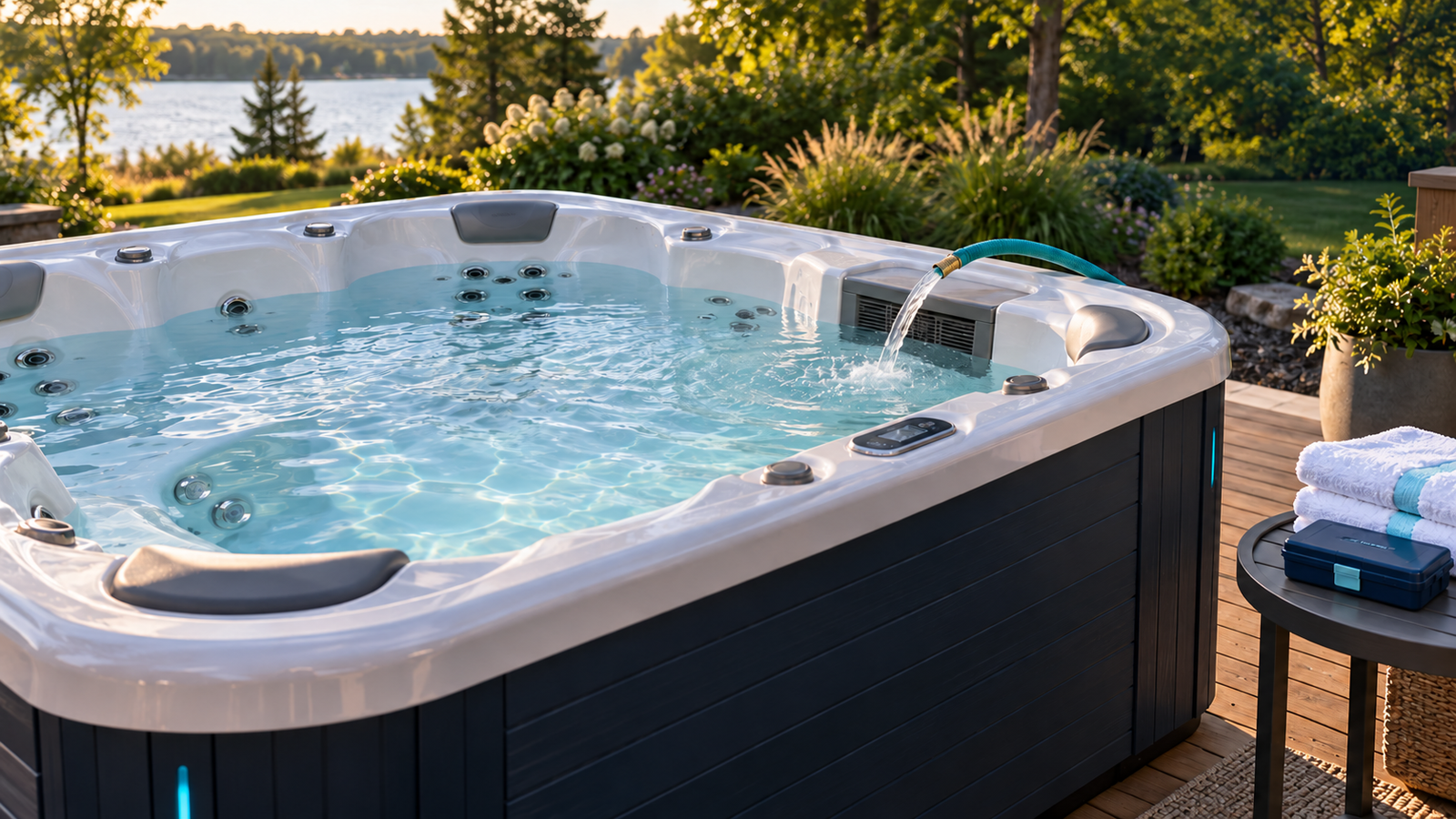
First Fill Made Easy: Hot Tub Startup Guide for New Owners
Your hot tub is in place, the hose is ready, and you’ve probably already picked out your favorite seat. Now for the question almost every new owner asks: “How soon can I get in?”
There are a few things to do first, but getting started doesn’t have to be complicated. This hot tub startup guide will walk you through filling, testing, balancing, and preparing the water so you can enjoy that first soak with confidence.
And if you’re refilling a hot tub you already own, these same steps will help you get back up and running.
💧 What You’ll Learn in This Report
What to have ready before filling your hot tub.
How to fill it and reduce the chance of an airlock.
What to look for when you turn on the power.
How to balance fresh water and start your sanitizer system.
What changes with chlorine, bromine, saltwater, and FROG @ease.
How to tell when your hot tub is ready to use.
What to watch during the first week.
Keep your owner’s manual and water-care instructions nearby. Your hot tub and sanitizer system may have specific filling procedures, water-balance targets, and startup steps. Use this guide to understand the process, then follow the directions for your setup.
1. Get Everything Ready Before You Fill 🧰
A little preparation now can save you a trip to the store halfway through startup—or the discovery that the drain is still open.
First, make sure the installation and electrical work are complete. Keep the power off while the hot tub is empty and during filling.
Gather what you’ll need:
Your owner’s manual and hot tub’s water capacity.
A clean garden hose.
A hose prefilter, if appropriate for your water.
Test strips or a test kit suitable for your sanitizer system.
Your water-balancing and startup products.
A clean, soft cloth.
Make sure the drain is closed and capped as required, the filter compartment is free of debris, and your filters are ready.
Knowing your water capacity matters. A chemical dose for a 500-gallon hot tub could be far too much for a 250-gallon model.
And “about a capful” only works when the label actually calls for a capful.
2. Start With a Clean Hot Tub 🧽
Before turning on the hose, look over the shell, seats, footwell, and filter compartment. Remove dirt, leaves, and anything else you don’t want floating beside you.
Use a manufacturer-approved cleaning method and rinse away any residue. Avoid dish soap and household cleaners that can create foam or damage surfaces.
If you’re doing a routine drain and refill, plan your plumbing purge before draining the old water. Follow the plumbing cleaner’s directions, then drain, remove the loosened residue, clean the shell, and deep-clean the filters.
Fresh water won’t remove buildup that’s still inside the plumbing.
For a brand-new hot tub, ask your dealer what preparation is recommended before the first fill. New doesn’t necessarily mean the inside has remained completely dry since factory testing.
If you’ve purchased a used hot tub with an unknown history, or yours has been sitting with stagnant water, get guidance on cleaning and disinfection before using it. A plumbing cleaner and a disinfectant do different jobs.
3. Know What’s Coming Out of Your Hose 🚰
Not everyone starts with the same water.
One homeowner may have hard water with a high alkalinity reading. Another may have softened water with very little calcium. Well water can bring its own challenges, including metals that may cause discoloration or staining.
Testing your source water—or taking a sample to your dealer—gives you a useful starting point.
Pay attention to:
Total alkalinity.
pH.
Calcium hardness.
Metals, if you use well water or have a history of staining.
A hose prefilter may help with certain metals, sediment, or other contaminants, depending on the filter. However, don’t assume every prefilter removes calcium or softens the water.
Can you use softened water?
That depends on your hot tub and sanitizer system. Some setups need calcium added back into softened water, while certain saltwater systems require much lower hardness.
The important part is knowing what your system needs before deciding which water source to use.
4. Fill Your Hot Tub Through the Recommended Location 💦
With the power still off, place the hose where your owner’s manual recommends.
Some manufacturers direct you to fill through the filter compartment or a particular opening. This can help water enter the plumbing while reducing trapped air.
Follow the instructions for your model, including any directions for removing filters or opening jets during filling.
Fill to the designated water level. Too little water can interfere with circulation, while overfilling can create problems once people climb in.
As the water rises, look around the drain and cabinet for unexpected water. Investigate a suspected leak before moving on.
When filling is complete, remove the hose and reinstall any filters or components as directed.
5. Turn On the Power and Confirm Water Flow 🔄
Now follow your hot tub’s startup or priming procedure.
Before worrying about how quickly it will heat, make sure water is moving normally.
Look for:
Water moving through the jets when each jet pump is activated.
Normal circulation for your model.
Unusual pump noises.
Flow warnings or other messages on the display.
Visible leaks.
A pump making noise doesn’t always mean it’s moving water.
If you hear the motor but get little or no water from the jets, air may be trapped inside the pump. That’s an airlock, and it can happen after a refill.
Don’t let a pump keep running without water flow. Stop it and follow the troubleshooting procedure in your manual. If normal flow doesn’t return, contact your dealer.
Getting the water moving properly comes before adding chemicals or settling in for a soak.
6. Test and Balance the Fresh Water 🧪
Clear water can still need adjustments. You can’t tell whether the pH or alkalinity is correct just by looking at it.
Once circulation is established, follow your water-care program’s startup instructions, including any water-temperature requirements.
These are the three main balance readings you’ll be working with:
| Reading | What It Means for Your Hot Tub |
|---|---|
| Total alkalinity | Helps keep pH from changing too easily. |
| pH | Tells you how acidic or basic the water is. |
| Calcium hardness | Measures the calcium in the water; the right level depends on your hot tub and system. |
Start with alkalinity, then fine-tune pH, unless your system’s instructions specify a different sequence. The two work together, so getting alkalinity in line first can make pH easier to manage.
Calcium hardness also needs attention. Don’t assume a target that works for one hot tub is right for another, especially when comparing conventional and saltwater systems.
Keep the adjustment process simple:
Test the water.
Compare your readings with the recommended ranges.
Measure the appropriate dose for your water capacity.
Add the product as directed.
Allow the required circulation time.
Retest before adding more.
Small, measured adjustments are easier to manage than correcting an overdose.
Add products separately, never mix chemicals together, and only predissolve a product when its label directs you to do so.
7. Start Your Sanitizer System 🛡️
Chlorine
Use a chlorine product approved for your hot tub and follow its startup directions.
After adding it, allow the water to circulate as instructed, then test the chlorine level. Make sure it’s within the recommended range and that you’ve followed the label’s waiting time before soaking.
Adding chlorine is the first step. Testing tells you whether you’ve added enough—or need to wait for the level to come down.
Bromine
Some bromine programs begin with a sodium bromide starter, followed by an appropriate oxidizer. In simple terms, this establishes a reserve that can be converted into active bromine.
Other products have their own startup process, so follow the directions for the system you’re using.
Dropping tablets into a floater doesn’t mean freshly filled water is immediately ready. Complete the startup treatment, allow the products to work as directed, and test before getting in.
Saltwater
A saltwater chlorine system makes chlorine from dissolved salt. It still needs properly balanced water and enough chlorine present before you soak.
Follow your system’s directions for:
Calcium hardness and water balance.
Salt level.
Minimum operating temperature.
Initial chlorine additions.
Output settings and follow-up testing.
The system may need a separate chlorine addition during startup while it begins producing chlorine.
Think of startup as getting the water ready for the system to maintain. Simply adding salt and turning it on doesn’t finish the job.
FROG @ease
Follow the instructions for your particular floating or built-in FROG @ease system.
Startup includes balancing the water, completing the prescribed startup treatment, and setting the cartridges for your hot tub.
Use the recommended FROG @ease test strips and follow their directions. SmartChlor has a different testing approach from conventional chlorine, which can be confusing if you’re switching systems.
What about ozone, UV, and enzymes?
These can support water care, but they don’t replace the sanitizer required by your program.
Also, non-chlorine shock—often called MPS—doesn’t add chlorine. Use it where your water-care instructions call for it, rather than treating every product labeled “shock” as interchangeable.
8. Let the Water Heat 🌡️
Once normal flow is confirmed, heating and water preparation may happen at the same time. Some products need the water to reach a certain temperature first, so follow their instructions.
How quickly your hot tub heats depends on:
- The temperature of the fill water.
- How much water it holds.
- Heater size.
- Outdoor conditions.
- Whether the heater can operate while the jets run on high speed.
A plug-in 110/120-volt hot tub generally takes longer to heat than a model configured for a higher-output 220/240-volt heater. On some plug-in models, turning the jets to high speed also pauses heating.
Your manual or dealer can give you a more useful estimate for your particular model than a universal “ready in a few hours” promise.
Use the cover to help retain heat when appropriate, while following product directions about keeping it open after chemical additions.
There’s no reason to turn the temperature straight to the maximum. For many adults, 100°F is a comfortable starting point. Adjust to your comfort and circumstances, stay within the manufacturer’s limits, and never exceed 104°F.
9. Run Through Your First-Soak Checklist ✅
The water is warm, the jets are working, and your favorite seat is waiting.
Before climbing in, make sure:
- The water level is correct.
- Pumps and circulation are operating normally.
- There are no unresolved leaks, warnings, or flow problems.
- The water is clear.
- Water balance meets your system’s requirements.
- Testing confirms the appropriate sanitizer level for use.
- Required chemical waiting times have passed.
- The temperature is appropriate for everyone using the hot tub.
Warm water isn’t the same thing as ready water.
A quick rinse before soaking helps reduce the lotions, sweat, and other products going into your freshly prepared water.
Afterward, follow your system’s after-use care instructions and secure the cover.
10. Give Your Hot Tub Some Attention During the First Week 📆
The first week is when you start learning how your hot tub responds to your household.
Two people enjoying a quiet soak can place a different demand on the sanitizer than a weekend gathering with friends. Your care routine needs to keep up with how the hot tub is actually being used.
Test sanitizer and pH before soaking, and follow your system’s testing schedule between uses.
Keep an eye on:
- Sanitizer levels after use.
- pH changes.
- Water level.
- Water clarity.
- Filter condition.
- Saltwater output settings, if applicable.
A few notes on your phone can help. Record your readings, what you added, and how much the hot tub was used.
That’s much easier than trying to remember whether you added something yesterday or three days ago.
If the water becomes cloudy or sanitizer repeatedly drops below the required level, resolve the problem before soaking. More products aren’t always the answer; testing helps you figure out what the water actually needs.
Common Hot Tub Startup Mistakes ⚠️
Most startup headaches begin with rushing or guessing.
Avoid these common mistakes:
- Turning on the power before filling.
- Filling to the wrong water level.
- Continuing to run a pump with no water flow.
- Guessing water capacity or chemical doses.
- Adding several products without allowing the required time between them.
- Assuming every sanitizer system uses the same water-balance targets.
- Expecting a saltwater system to prepare the water instantly.
- Skipping testing because the water looks clear.
- Getting in before chemical instructions allow it.
You don’t need a shelf full of products or a complicated routine. You need the right products, reliable testing, and enough time for each step to do its job.
Frequently Asked Questions ❓
How long after filling can I use my hot tub?
That depends on how quickly it heats and how much preparation the water needs. Some hot tubs may be ready later the same day; others take longer. Before getting in, confirm normal operation, proper water balance, an appropriate sanitizer level, and completion of all chemical waiting times.
Should I fill my hot tub with hot or cold water?
Follow your manufacturer’s fill-temperature guidance. Don’t pour very hot water into an empty hot tub to speed things up. If your source water is unusually cold, look for any minimum fill-temperature requirements in the manual.
Do I add chemicals before or after heating?
There isn’t one rule for every product. Some can be added during heating, while others require a particular temperature. Establish normal circulation first, then follow the startup sequence for your system.
Can I fill my hot tub with well water?
Well water may be suitable, but testing is especially helpful. Hardness and metals can affect how you prepare it. A prefilter may help with certain contaminants, but choose one based on what’s actually in your water.
Do I need to shock freshly filled water?
Follow your sanitizer program’s startup directions. It may call for an initial chlorine dose or another startup treatment. Chlorine shock, non-chlorine shock, and system-specific startup products do different jobs, so use the one your program requires.
Why are my jets not working after a refill?
Trapped air is one possible cause, particularly if you hear the pump running but see little or no water movement. Stop the pump and follow your model’s priming instructions. Don’t keep running it without flow.
Why is my freshly filled hot tub cloudy?
Water-balance problems, residue, or inadequate sanitation and filtration may contribute. Test the water and confirm normal circulation before adding more products. Clarifier won’t correct every cause of cloudy water.
Does a new hot tub need a plumbing purge?
Ask your dealer what preparation is recommended. Factory testing and storage can leave residual water, but the appropriate cleaning process depends on the hot tub’s condition and manufacturer’s instructions. A used hot tub with an unknown history needs additional consideration.
🧠 Final Thoughts
Starting your hot tub doesn’t have to feel like a chemistry exam.
Take it one step at a time: prepare the hot tub, fill it correctly, confirm water flow, balance and sanitize the water, and make sure everything is ready before getting in.
The first startup may take a little extra attention because everything is new. Once you’ve done it, the next drain and refill will feel much more familiar.
And that favorite seat? It’ll still be waiting.
💬 Your Hot Tub Is Ready. Let’s Keep It That Way.
Your hot tub is filled, the water is balanced, and you’re ready to enjoy it. Now let’s make keeping it that way a little easier.
Read next: Hot Tub Water Care 101 for straightforward help with testing, sanitizer, and the everyday habits that keep your water in good shape.
Looking for Another Hot Tub Answer?
Search The Hot Tub Report for more water care, troubleshooting, and buying advice.
Trusted Links & References
A Little More Hot Tub Know-How, Delivered
Get practical water care tips, maintenance advice, and helpful reports delivered right to your inbox. It’s free, and it’s all about making hot tub ownership a little easier.
HOT TUB CONCIERGE SERVICE
Need a Little More Help?
Sometimes a little one-on-one guidance makes all the difference.
Whether you’re shopping for a hot tub, troubleshooting a water problem, or just looking for some expert advice, I’m here to help.
Get personalized guidance during a 30-minute Hot Tub Concierge consultation.
Recommended Reads From The Hot Tub Report
Looking for more helpful advice? Explore these related reports for additional hot tub tips, practical guidance, and answers to common ownership questions.
💬 Join the Conversation!
Have a question, a helpful tip, or a hot tub experience to share? Drop a comment below! We’re here to help each other enjoy better hot tub ownership.
Please keep comments friendly, helpful, and on topic.