Hot Tub Water Care 101

💧 Hot Tub Water Care 101: A Beginner’s Guide to Clean, Clear & Balanced Water
Owning a hot tub should mean more time relaxing and less time standing beside it wondering which chemical to add next.
But when you’re new to hot tub ownership, water care can feel overwhelming.
You test the water and suddenly you’re dealing with sanitizer, pH, alkalinity, calcium hardness, shock, filters, circulation, salt systems, ozone, enzymes, clarifiers, and a shelf full of bottles promising to fix everything from cloudy water to foam.
The good news?
Hot tub water care doesn’t have to be complicated.
You don’t need to become a chemist. You simply need to understand what you’re testing, why each measurement matters, what order to make adjustments in, and how to establish a simple maintenance routine.
This beginner’s guide will walk you through those fundamentals—from your first fill to your weekly water-care routine.
🎓 What This Report Helps You Master
By the end of this guide, you’ll understand:
- The four measurements that form the foundation of hot tub water care
- Why sanitizer is essential—even when your water looks perfectly clear
- The difference between pH and total alkalinity
- Why calcium hardness matters
- The proper order for balancing fresh hot tub water
- What hot tub shock actually does
- How often you should test your water
- Why circulation and filtration matter just as much as chemistry
- How to prevent common problems like cloudy water and foam
- When it’s time to drain and refill
- The most common mistakes new hot tub owners make
- How to create a simple weekly maintenance routine
Let’s start with the foundation.
Hot Tubbing 101 Topics
🧪 The Four Pillars of Hot Tub Water Balance
Most hot tub water problems can be traced back to four basic measurements:
- Sanitizer
- Total Alkalinity
- pH
- Calcium Hardness
Think of these as the Four Pillars of healthy hot tub water.
Your sanitizer keeps the water sanitary.
Alkalinity helps stabilize your pH.
pH controls how acidic or basic the water is.
Calcium hardness helps maintain proper water characteristics and protect your spa.
Get these fundamentals right, and many common water problems become considerably easier to prevent and troubleshoot.
Beginner Hot Tub Water-Care Targets
For many traditional residential hot tubs, useful general starting ranges are:
- Free Chlorine: approximately 1–3 ppm
- Total Alkalinity: approximately 80–120 ppm
- pH: approximately 7.2–7.8
- Calcium Hardness: approximately 150–250 ppm
These are general guidelines—not universal specifications.
Always follow the recommendations of your hot tub manufacturer and your specific water-care system when they differ.
🛁 Why Hot Tub Water Requires Special Care
A hot tub isn’t simply a small swimming pool.
Hot tubs operate at high temperatures, contain a relatively small amount of water, and may have several people soaking in only a few hundred gallons.
Every person entering the spa introduces contaminants such as:
- Sweat
- Body oils
- Lotions
- Cosmetics
- Hair products
- Dead skin cells
- Deodorant
- Detergent residue from swimsuits
Because there isn’t much water to dilute those contaminants, water conditions can change relatively quickly.
That’s why successful hot tub water care depends on several systems working together:
Sanitation + Water Balance + Oxidation + Circulation + Filtration + Contamination Control
Let’s break them down.
🦠 Pillar #1: Sanitizer
Your sanitizer has one extremely important job:
Keep the water sanitary.
Warm hot tub water can provide an environment where bacteria and other microorganisms grow quickly. Maintaining an appropriate sanitizer residual helps control those contaminants.
Two of the most common traditional sanitizers are chlorine and bromine.
Chlorine
Chlorine works quickly, is widely available, and is relatively inexpensive.
Many traditional hot tub owners use granular dichlor chlorine because it’s convenient and dissolves quickly.
One thing to understand about dichlor is that it also introduces cyanuric acid, or CYA, into the water. Repeated use can cause CYA to accumulate over time, which is another reason periodic water replacement can become important.
Bromine
Bromine is another popular sanitizer for hot tubs and can work particularly well when used as part of a properly maintained bromine system.
Bromine and chlorine have different recommended residuals, so don’t use their target numbers interchangeably.
What About Saltwater Hot Tubs?
A saltwater hot tub is still a sanitized hot tub.
Most spa salt systems use a small amount of salt in the water and convert that salt into chlorine.
In other words:
Saltwater doesn't mean chlorine-free.
The primary difference is how the sanitizer is produced. Instead of relying entirely on manually adding chlorine, the system generates small amounts over time.
Salt systems can simplify certain parts of water care, but you’ll still need to pay attention to water balance, filtration, circulation, and the requirements of your particular system.
And remember:
Clear water doesn’t automatically mean sanitary water.
Your water can look beautiful and still have an inadequate sanitizer level.
⚖️ Pillar #2: Total Alkalinity
Total alkalinity is one of the most misunderstood parts of hot tub water chemistry.
Its primary job is to help stabilize pH.
Think of alkalinity as your pH buffer.
When alkalinity is reasonably balanced, it helps prevent pH from making large, unpredictable swings.
When alkalinity is too low, you may experience:
- Rapidly changing pH
- Difficulty maintaining stable chemistry
- Potentially corrosive water conditions
When alkalinity is too high, you may experience:
- Persistently high or rising pH
- Difficulty lowering pH
- Cloudy water
- Increased potential for scale
That’s why, when balancing fresh water, total alkalinity is normally addressed before making your final pH adjustment.
📊 Pillar #3: pH
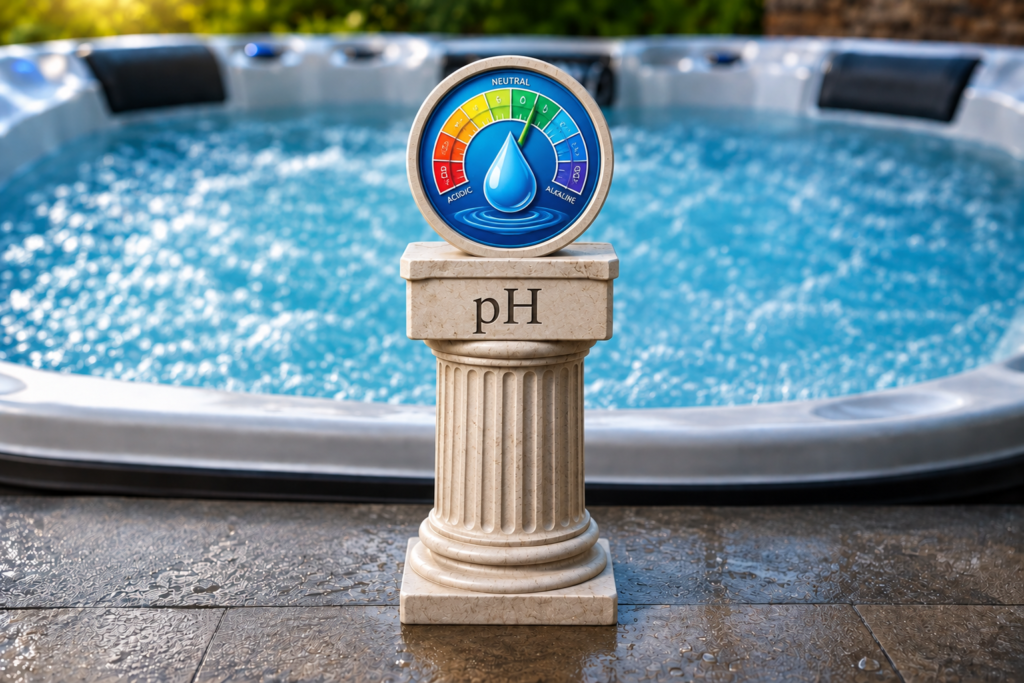
pH tells you how acidic or basic your hot tub water is.
For many residential hot tubs, a useful general range is:
7.2–7.8
Maintaining pH within the proper range affects:
- Sanitizer performance
- Bather comfort
- Equipment protection
- Water clarity
- Scale formation
Low pH can contribute to:
- Corrosion
- Equipment damage
- Skin and eye irritation
High pH can contribute to:
- Cloudy water
Scale - Reduced chlorine effectiveness
- Deposits on spa surfaces and equipment
One thing that surprises many beginners is that hot tub pH often tends to rise.
Why?
Aeration.
When your jets introduce air into the water, carbon dioxide can leave the water and pH can increase.
So if your pH tends to rise after running your jets, that doesn’t necessarily mean you’re doing something wrong.
And if you’re constantly fighting pH, look at your alkalinity before repeatedly adding pH-adjusting chemicals.
🪨 Pillar #4: Calcium Hardness
It doesn’t usually change as quickly as sanitizer or pH, but it’s still an important part of balanced water.
For many traditional acrylic hot tubs, a general target is approximately:
>150–250 ppm
Again, follow the requirements for your particular spa and water-care system.
Too little calcium can contribute to:
- Aggressive water conditions
- Foaming
- Potential problems with certain spa materials and components
Too much calcium can contribute to:
- Scale
- Cloudy water
- Deposits on surfaces
- Scale buildup around heaters and plumbing
Hot water increases the potential for calcium scale, making hardness an important measurement to get right.
🚿 Starting With Fresh Hot Tub Water
Good water care starts before you add your first chemical.
When filling your spa, consider using a hose pre-filter, particularly if your source water contains sediment, metals, or other unwanted contaminants.
Once the spa is filled and circulating, test your source water.
You want to know where you’re starting before making adjustments.
For a typical fresh fill, a practical sequence is:
Fill → Circulate → Test → Adjust Calcium Hardness if necessary → Balance Total Alkalinity → Adjust pH → Establish Sanitizer
Then complete any additional startup procedure required by your particular sanitation or water-care system.
The most important rule is simple:
Don’t randomly add chemicals. Test first.
Make deliberate adjustments and give the water appropriate time to circulate before deciding what it needs next.
⚡ What Does “Shocking” a Hot Tub Mean?
“Shock” is one of those hot tub terms that creates unnecessary confusion.
Shock isn’t necessarily one particular product.
It’s better to think of shocking as an oxidation process.
Your sanitizer helps control microorganisms. Oxidation helps break down contaminants introduced by bathers, including:
- Sweat
- Body oils
- Lotions
- Cosmetics
- Other organic material
Depending on your water-care system, oxidation may involve a chlorine-based product or a non-chlorine oxidizer such as MPS.
How often you need to oxidize depends on your sanitation system, manufacturer recommendations, and how heavily the spa is being used.
More bathers generally mean more contaminants—and greater demand on your water-care system.
🔬 How Often Should You Test Hot Tub Water?
You can’t determine whether your hot tub is properly balanced just by looking at it.
For many residential hot tubs, testing at least 1–2 times per week is a good starting point.
Test more frequently when:
- The hot tub is new
- You’re learning how your water behaves
- Several people have recently soaked
- You’ve made significant chemical adjustments
- The water doesn’t look or smell normal
At minimum, regularly monitor:
- Sanitizer
- pH
- Total alkalinity
Calcium hardness, CYA when applicable, salt levels for salt systems, and other measurements can be checked according to the needs of your particular water-care program.
Test Strips or Liquid Test Kit?
Both can have a place in hot tub ownership.
Test strips are convenient for quick routine checks when they’re fresh, properly stored, and read correctly.
A good liquid drop test kit can provide greater precision when troubleshooting or trying to dial in your chemistry.
Whichever method you choose, consistency matters more than owning the fanciest test kit.
🔄 Don't Overlook Circulation
Chemicals can’t work effectively if your water isn’t moving.
Good circulation helps:
- Distribute sanitizer
- Mix chemicals
- Move contaminants toward the filter
- Reduce stagnant areas
- Improve overall water quality
Some hot tubs use a dedicated circulation pump, while others use programmed filtration cycles through one of the primary pumps.
Either approach can work when the system is properly designed and configured.
The important thing is that your water is circulating and your filtration schedule is appropriate for how you use your spa.
🧼 Your Filter Is Part of Water Care
Chemistry gets most of the attention, but your filter is doing a tremendous amount of work behind the scenes.
It captures physical contaminants and debris that you don’t want remaining in the water.
A dirty filter can contribute to:
- Cloudy water
- Reduced circulation
- Poor filtration
- Increased sanitizer demand
- Weak jet performance
- Flow or heater errors
A simple routine goes a long way.
Regularly: Rinse the filters thoroughly with a garden hose.
Periodically: Deep-clean them with an appropriate filter-cleaning product.
Eventually: Replace filters that are worn, damaged, or have reached the end of their recommended service life.
Remember:
You cannot chemically balance your way out of poor filtration.
Great hot tub water requires both proper chemistry and effective filtration.
👙 Control What Goes Into Your Hot Tub
One of the easiest ways to improve your hot tub water doesn’t involve adding another chemical.
It involves keeping contaminants out in the first place.
Before soaking, try to minimize:
- Body lotion
- Sunscreen
- Makeup
- Hair products
- Body oils
- Detergent and fabric-softener residue on swimsuits
A quick rinse before soaking can make a noticeable difference.
Swimsuit detergent residue is also a common contributor to persistent hot tub foam. Consider thoroughly rinsing hot tub swimsuits and limiting the amount of detergent and fabric softener used on them.
The less contamination entering your spa, the less work your sanitizer, oxidizer, and filter have to do.
🌫️ Cloudy Water Is a Symptom, Not a Diagnosis
When your hot tub becomes cloudy, resist the urge to immediately reach for a clarifier.
Cloudiness can have many causes, including:
- Low sanitizer
- Heavy bather load
- Dirty filters
- Poor circulation
- High pH
- Improper alkalinity
- Accumulated contaminants
- Biofilm
- Old water
Instead of treating only the appearance of the water, troubleshoot the underlying cause.
A useful sequence is:
Test → Correct Chemistry → Clean Filters → Verify Circulation → Oxidize if Appropriate → Reassess
Fix the cause and the symptom will often take care of itself.
🫧 Why Does My Hot Tub Foam?
Some bubbles are perfectly normal when powerful jets are operating.
Persistent foam is different.
Common contributors include:
Detergent residue
- Body oils
- Lotions
- Cosmetics
- Low calcium hardness
- High levels of dissolved organic material
- Aging water
A defoamer may temporarily knock the foam down, but it doesn’t remove the contaminants causing it.
If foam keeps returning, find the source instead of repeatedly treating the symptom.
Test → Correct Chemistry → Clean Filters → Verify Circulation → Oxidize if Appropriate → Reassess
Fix the cause and the symptom will often take care of itself.
🦠 A Quick Word About Biofilm
Biofilm is a protective layer of microorganisms and organic material that can develop inside hot tub plumbing.
Because much of your plumbing is hidden, biofilm can sometimes be present even when the visible spa surfaces look clean.
Possible warning signs include:
- Sanitizer disappearing unusually quickly
- Recurring cloudy water
- Persistent odors
- Slime or unusual debris
- Water problems that repeatedly return after treatment
When biofilm is suspected, a dedicated spa plumbing purge may be appropriate before draining and refilling the spa.
🔄 When Should You Drain and Refill?
Chemistry can’t solve everything.
As hot tub water ages, dissolved material accumulates. Bathers introduce contaminants.
Chemicals are added. Water evaporates while minerals and other dissolved material remain behind.
Eventually, maintaining the water becomes increasingly difficult.
Many traditional hot tubs are drained and refilled approximately every 3–4 months, although the correct interval depends on:
- Spa size
- Number of bathers
- Frequency of use
- Water-care system
- Source water
- Chemical usage
- Manufacturer recommendations
Some specialized systems may allow considerably longer intervals when properly maintained.
Fresh water gives you a clean starting point and often makes water chemistry dramatically easier to manage.
🧹 Make the Most of a Drain and Refill
A water change is an opportunity to reset more than just the chemistry.
Depending on your spa and its condition, consider:
- Purging the plumbing when appropriate
- Draining the spa
- Cleaning the shell
- Cleaning the filters
- Inspecting the filter compartment
- Checking the equipment area
- Refilling through the manufacturer’s recommended location
- Testing the source water
- Rebalancing the new water
- Restarting your sanitizer system
If you repeatedly experience the same water-quality problem after refilling, don’t just keep changing the water.
Find the underlying cause.
🪣 How Many Chemicals Does a Beginner Really Need?
Probably fewer than you think.
A basic traditional hot tub program may include:
- Your primary sanitizer
- pH increaser
- pH decreaser
- Alkalinity increaser
- Calcium hardness increaser, if your source water requires it
- An appropriate oxidizer
- Filter cleaner
- A plumbing purge product when needed
Additional products can certainly be useful depending on your water and sanitation system.
But here’s a good rule:
Every chemical you add has a specific job.
Don’t add a product simply because it’s sitting on the shelf.
🚨 Common Beginner Water-Care Mistakes
Water care often becomes more difficult when owners try too hard to correct small problems.
- Adding chemicals without testing
Don’t guess. Know what needs adjustment first.
- Adjusting pH while ignoring alkalinity
If alkalinity isn’t properly managed, pH can become frustratingly difficult to control.
- Letting sanitizer repeatedly fall too low
Clear-looking water isn’t a substitute for proper sanitation.
- Keeping old water too long
Sometimes the best chemical for difficult water is simply fresh water.
- Adding too much at once
More isn’t necessarily better. Small, measured corrections are usually easier to control.
- Ignoring the filters
Perfect-looking chemistry won’t compensate for severely restricted filtration.
- Mixing concentrated chemicals
Never mix concentrated hot tub chemicals together.
Follow product labels, add chemicals individually, and provide the appropriate circulation between additions.
📅 A Simple Hot Tub Maintenance Routine
Hot tub maintenance becomes much easier when you establish a repeatable routine instead of treating every change as an emergency.
Once or Twice Per Week
- Test sanitizer
- Test pH
- Check total alkalinity
- Adjust chemistry when necessary
- Check water clarity
- Inspect the waterline
- Confirm normal circulation
Weekly or As Needed
- Rinse the filter
- Look for foam, cloudiness, odors, or unusual deposits
- Account for heavier-than-normal bather use
- Oxidize according to your water-care system’s recommendations
Periodically
- Deep-clean filters
Inspect the hot tub cover - Clean the waterline
Check calcium hardness - Check CYA when applicable
- Check salt levels if using a salt system
- Inspect the equipment area for leaks or unusual conditions
Every Few Months
- Rinse the filter
- Look for foam, cloudiness, odors, or unusual deposits
- Account for heavier-than-normal bather use
- Oxidize according to your water-care system’s recommendations
The goal isn’t to spend hours maintaining your hot tub.
It’s to catch small changes before they become big problems.
🧠 The Beginner's Rule: Don't Chase the Water
This may be the most important lesson in Hot Tub Water Care 101.
New owners sometimes fall into a cycle:
Test.
Add something.
Test again immediately.
Add something else.
Then add another product to correct the previous adjustment.
Before long, they have no idea which chemical caused which change.
Instead, remember:
Test → Understand → Adjust → Circulate → Retest
Make small, deliberate corrections.
And most importantly, learn how your hot tub behaves.
Your sanitizer demand changes with use.
Aeration can affect pH.
Your source water influences alkalinity and calcium hardness.
Weather, evaporation, bathers, and water-care products all affect the system.
Eventually, instead of asking: “What chemical should I add?”
You’ll start asking: “Why did this measurement change?”
That’s when hot tub water care really begins to make sense.
♨️ Better Water Makes for Better Hot Tubbing
You don’t need to become a chemist to take care of a hot tub.
Master the fundamentals:
- Maintain your sanitizer.
- Balance your alkalinity.
- Keep pH in range.
- Manage calcium hardness.
- Maintain good circulation.
- Keep your filters clean.
- Control what enters the water. Test consistently.
- Oxidize when appropriate.
- And change the water when it’s time.
Get those fundamentals right before worrying about every specialty chemical on the shelf.
Good water care isn’t about using more chemicals.
It’s about understanding your water and giving it what it actually needs.
The reward is exactly what hot tub ownership should provide:
Clean water. Clear water. Comfortable water. And more time enjoying your hot tub.
👉 Ready to Learn More?
Explore The Hot Tub Report Water Care guides for straightforward help with sanitizer, alkalinity, pH, calcium hardness, cloudy water, foam, filtration, ozone, saltwater systems, biofilm, and other common hot tub water-care questions.
And if there’s a water-care problem you can’t quite figure out, leave your question in the comments. Your question may become the topic of a future Hot Tub Report.
The Hot Tub Report — Where Better Hot Tubbing Begins.
The Hot Tub Report Trusted Links & References
Recommended Reads from The Hot Tub Report
💬 Join the Conversation!
Have a question, tip, or hot tub story to share? Jump in! The Hot Tub Report is all about helping each other get more enjoyment out of hot tub ownership.
Just keep it friendly, helpful, and on topic. No spam, personal attacks, or inappropriate content, please. Comments that don’t fit the spirit of the community may be removed.
Be helpful. Be respectful. And happy hot tubbing! 🛁