Hot Tub Sanitizer Levels Explained
Hot Tub Sanitizer Levels Explained: How Much Is Enough?
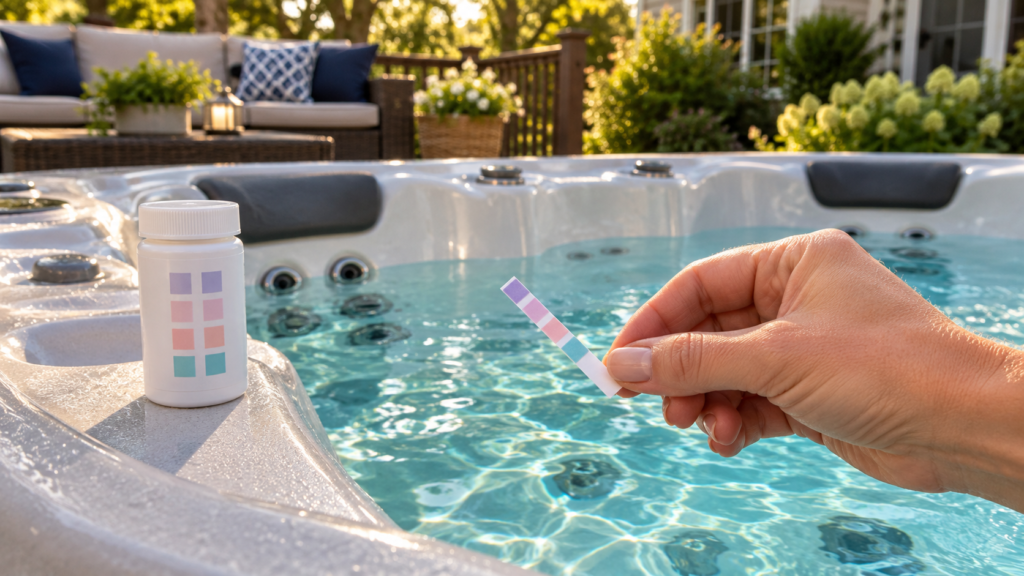
You dip a test strip into your hot tub, hold it next to the bottle, and stare at the colors.
Is that light purple or medium purple? Is the chlorine too low? And why does one set of instructions recommend a different number than another?
You were hoping for a relaxing soak—not a chemistry quiz.
The good news is that sanitizer levels become much easier to understand once you know what you’re measuring, which target applies to your system, and what to do when the reading is off.
Let’s walk through it.
💧 What You’ll Learn in This Report
- How much chlorine or bromine your hot tub needs.
- What free chlorine and total chlorine mean.
- Why your sanitizer system affects how you test.
- What causes sanitizer levels to drop.
- How to respond to low or high readings.
- How shocking fits into your water-care routine.
🧪 What Does Your Sanitizer Reading Actually Tell You?
Your sanitizer helps control bacteria and other microorganisms in the water.
When you test it, the result is usually expressed in parts per million, or ppm. That’s simply a way of measuring a small concentration of sanitizer in a much larger amount of water.
You’ll also hear the word residual. This means the sanitizer remaining in the water.
That distinction matters.
Adding chlorine yesterday tells you what went into the tub. Testing today tells you what remains after it has been working.
The goal is to maintain the appropriate sanitizer level consistently—not simply add the same scoop every few days and hope for the best.
And while sparkling water is certainly nice to see, appearance alone doesn’t tell you whether it’s properly sanitized.
🎯 How Much Sanitizer Is Enough?
| Sanitizer | General guidance |
|---|---|
| Chlorine | At least 3 ppm |
| Bromine | 3-5 ppm |
For conventional chlorine care, free chlorine is the reading to focus on. We’ll explain that next.
Why might your instructions show a different range?
Some complete sanitizer systems have specific directions that include lower residuals.
Make sure the target you’re following applies to the complete system you’re using. A lower target for a mineral-assisted system doesn’t automatically apply to a conventional chlorine routine.
If your chemical label and spa instructions conflict, ask the manufacturer or a knowledgeable dealer to clarify the correct routine.
Your neighbor’s water-care system may look similar to yours while working differently.
🔬 Free Chlorine vs. Total Chlorine: Which Number Matters?
This is one of the biggest sources of confusion, but the basic difference is straightforward.
Free Chlorine
This is the chlorine available to provide ongoing sanitation. In a conventional chlorine routine, it’s the main residual you’re checking.
Combined Chlorine
This is chlorine that has reacted with nitrogen-containing contaminants, such as those introduced through perspiration and other bather waste.
These compounds are often called chloramines.
Total Chlorine
This is free chlorine plus combined chlorine.
For example, your test might show 3 ppm total chlorine, but only 1 ppm free chlorine.
The total reading doesn’t mean you have 3 ppm available to do the work. Your free-chlorine reading is still only 1 ppm.
When choosing a test, check whether it measures free chlorine, total chlorine, or both.
SmartChlor is a special case, though. Its readings need a different interpretation.
📉 Why Does Sanitizer Disappear So Quickly?
Sometimes the answer is straightforward: your hot tub had more work to do.
More people, longer soaking sessions, perspiration, lotions, and body oils all contribute to demand.
The routine that works for two quiet evenings a week may not keep up with a Saturday night full of guests.
Other things to check include:
- An empty sanitizer cartridge or feeder.
- A delivery setting that’s too low.
- Insufficient salt-system output.
- Circulation or equipment problems.
- Dirty filters and accumulated contamination.
If sanitizer keeps disappearing after you’ve checked your testing method, sanitizer supply, and system settings, buildup in the plumbing may be contributing.
That’s when it’s worth exploring whether a plumbing purge is appropriate. Our Hot Tub Biofilm Treatment report explains what to look for.
Rapid sanitizer loss is a reason to investigate—not proof of biofilm by itself.
📋 Get a Test Result You Can Trust
Before adding more product, make sure the reading is useful.
A few small habits make a difference:
- Use a test designed for your sanitizer system.
- Check expiration dates.
- Store strips and reagents as directed, away from heat and moisture.
- Follow the sampling instructions.
- Read the result at the specified time.
- Allow treatments to circulate as directed before retesting.
A strip left on the counter while you answer a text may no longer show the result you were supposed to read.
If a number seems completely out of character, repeat the test. A suitable second test method or professional water analysis can help resolve confusing results.
Some treatments, including MPS, can interfere with certain tests.
⏰ How Often Should You Test?

Make checking sanitizer and pH before soaking part of your routine, and follow your system’s testing schedule between uses.
Additional checks are especially useful after heavy use, following adjustments, or when you’re investigating a water problem.
If you’re learning a new system, test often enough to understand how it behaves. Notice what happens after an ordinary soak compared with a weekend of guests.
An automatic feeder or generator can simplify sanitizer delivery, but it still needs verification.
Think of testing as a quick check that your routine is working. It’s much easier than trying to rescue the water after several days of guessing.
⬇️ What Should You Do If Sanitizer Is Too Low?
If sanitizer is below your system’s required range, hold off on soaking while you check the reading and correct the problem.
Then work through these steps:
- Confirm the reading. Use the correct test and repeat an unexpected result.
- Check pH. Keep it within your system’s specified range.
- Check the sanitizer supply. Inspect the cartridge, feeder, or generator.
- Correct the level according to the product instructions. Base any dose on your actual water volume.
- Circulate and retest before getting in.
If the level repeatedly drops, investigate why rather than continually increasing the dose.
⬆️ What If Sanitizer Is Too High?
More isn’t automatically better.
Confirm the result first. Then follow your system’s instructions for reducing or pausing sanitizer delivery and allowing the level to return to its bathing range.
Overcorrecting can leave you with the opposite problem.
Retest before getting back in, and confirm that sanitizer and pH meet your system’s bathing requirements.
A set amount of waiting time doesn’t tell you what’s actually left in the water.
🫧 Is Shocking the Same as Sanitizing?
Not quite. The easiest way to understand the difference is to look at what each treatment is meant to accomplish.
Sanitizing maintains enough chlorine or bromine in the water to control bacteria and other microorganisms. You need that protection throughout the week.
Every new soak introduces perspiration, body oils, and traces of personal-care products. Those contaminants give your water-care system more work to do.
Shocking is an additional treatment used to help handle that buildup. What it does depends on the product you use.
Shocking With Chlorine
A chlorine-based shock treatment raises the chlorine level to help oxidize contaminants while also providing sanitation.
Follow the product’s treatment instructions and confirm the water is within the recommended bathing range before getting back in.
Shocking With MPS
MPS is a non-chlorine shock that helps with the cleanup. Through oxidation, it helps break down some of the organic residue introduced by perspiration, skin oils, and personal-care products. That can reduce some of the workload on your chlorine.
MPS doesn’t supply chlorine. If your free chlorine reads zero, adding MPS alone won’t restore it. Depending on your system’s instructions, the water may need both a chlorine adjustment and a shock treatment with MPS.
A testing caution: MPS can temporarily interfere with some chlorine tests, especially total-chlorine tests, making total or calculated combined chlorine appear higher than it actually is.
What About Bromine?
In a bromine system, MPS can do another useful job: it can convert inactive bromide already in the water back into active bromine.
That’s why your bromine reading may rise after adding MPS even though the product contains no bromine.
Shocking is a periodic treatment; sanitation is an ongoing requirement. A weekly shock treatment doesn’t replace maintaining the correct sanitizer level between treatments.
❓ Common Sanitizer Questions
Can I Soak If the Sanitizer Reads Zero?
No. Confirm the reading and correct the problem before use. Clear water doesn’t make a zero reading acceptable.
Does a Strong Chlorine Smell Mean I Added Too Much?
Not necessarily. Smell alone cannot identify the chlorine concentration or the cause of a problem.
Test sanitizer and pH rather than deciding whether to add or reduce chlorine by your nose.
Why Is My Saltwater Tub Low on Chlorine?
Generation may not be keeping up with demand, or the system may need attention.
Check its output, operating status, and troubleshooting instructions—not just the salt reading.
How Soon Can I Soak After Adding Sanitizer?
Follow the product’s circulation and waiting instructions, then verify that sanitizer and pH are within the required bathing range.
There isn’t one waiting time that fits every product and dose.
Can I Keep Sanitizer Extra Low Because My Skin Is Sensitive?
Don’t deliberately run below your system’s required level.
Check for excessive sanitizer, incorrect pH, and other water problems instead. If irritation continues, speak with your healthcare provider.
✅ Make Sanitizer Care a Simple Habit
You don’t need to become a chemist to take good care of your hot tub.
Start with three habits:
Know your system. Use the right test. Maintain the required residual.
Once you understand what your reading means, you can make more informed adjustments and spend less time wondering whether you added too much—or not enough.
🤝 Need Help Making Sense of Your Readings?
For more help choosing a routine, explore The Hot Tub Report’s guide to chlorine versus bromine and our other water-care reports.
If your readings keep leaving you puzzled, the Hot Tub Concierge Service offers one-on-one help reviewing your routine and figuring out what to check next.
What gives you the most trouble—sanitizer that drops too quickly, readings that stay too high, or knowing which number to trust?
The Hot Tub Report Trusted Links & References
Recommended Reads from The Hot Tub Report
💬 Join the Conversation!
Have a question, tip, or hot tub story to share? Jump in! The Hot Tub Report is all about helping each other get more enjoyment out of hot tub ownership.
Just keep it friendly, helpful, and on topic. No spam, personal attacks, or inappropriate content, please. Comments that don’t fit the spirit of the community may be removed.
Be helpful. Be respectful. And happy hot tubbing! 🛁