Which Chlorine Is Best: What to Use, What to Avoid
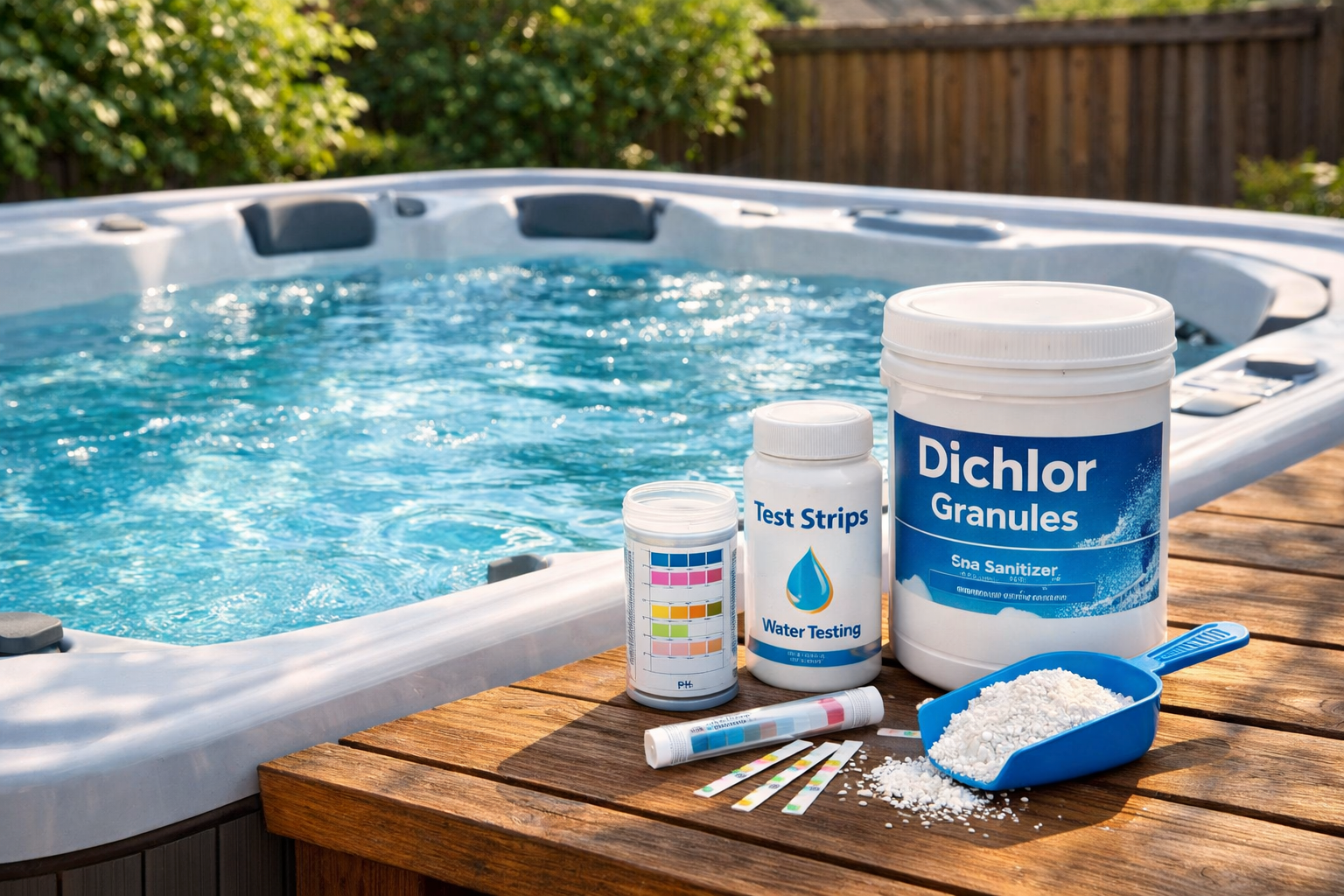
Which Chlorine Is Best for Hot Tubs? A Clear, No‑Nonsense Guide
Choosing chlorine for your hot tub sounds simple—until you’re standing in front of a shelf full of tablets, granules, and liquids. The labels may all promise clean, clear water, but that doesn’t mean every product belongs in your hot tub.
When I first entered the pool and hot tub industry, that variety could be confusing. The useful starting point is the active ingredient, followed by the directions on the label and the requirements in your hot tub’s owner’s manual.
In this report, we’ll look at the main chlorine types, how they affect water balance, and what to consider before choosing one. You don’t need to become a chemist—you just need to understand what you’re adding and how it fits your water-care routine.
What You’ll Learn in This Report
- How to identify the chlorine type by its active ingredient
- What free chlorine and combined chlorine mean when you test your water
- How dichlor, trichlor, cal-hypo, and liquid chlorine differ
- Why your hot tub’s instructions and the product label matter
- How stabilizer buildup can affect your water-care routine
- What to consider when testing, adjusting, and maintaining your sanitizer level
🧪 How Chlorine Cleans Your Hot Tub Water
Chlorine does two important jobs: it disinfects the water by inactivating germs, and it oxidizes some of the contaminants introduced during use.
Every soak adds to that workload. Sweat, skin oils, lotions, and other substances can consume chlorine, which helps explain why your reading may drop after a busy evening in the hot tub.
Sanitizing and Oxidizing
Sanitizing helps control germs in the water. Oxidizing helps break down certain contaminants. Chlorine can do both, but it doesn’t remove everything or turn every substance it encounters into a harmless byproduct.
That’s why sanitizer works alongside filtration, filter cleaning, and regular water replacement. Each handles a different part of keeping your hot tub ready to use.
Clear Water Is Only Part of the Picture
Water can look clear even when the sanitizer level is too low. Appearance and smell won’t tell you whether enough chlorine remains.
Testing gives you a more useful picture. To understand the results, it helps to know the difference between free chlorine and combined chlorine.
🧪 Free Chlorine and Combined Chlorine Explained
When you test your hot tub water, you may see readings for free chlorine, total chlorine, and combined chlorine. They describe different parts of what’s happening in the water.
Free Chlorine: Your Available Sanitizer
Free chlorine is the portion available to disinfect the water. It’s the reading you use to monitor your chlorine residual—the amount remaining after the water’s immediate demand has been met.
The number matters, but so does water balance. Factors such as pH and cyanuric acid affect how quickly chlorine works, so a free-chlorine reading alone doesn’t tell the whole story.
Combined Chlorine: Chlorine That Has Reacted
When chlorine reacts with certain nitrogen-containing contaminants, including those introduced by bathers, it can form chloramines. These contribute to the combined-chlorine reading.
Some chloramines can cause strong odors and irritation. A rising combined-chlorine reading deserves attention, but it doesn’t automatically mean all your free chlorine has disappeared.
How the Readings Fit Together
Total chlorine = free chlorine + combined chlorine.
If your test measures both free and total chlorine, subtract free chlorine from total chlorine to calculate combined chlorine.
For example, a total-chlorine reading of 4 ppm and a free-chlorine reading of 3.5 ppm gives you 0.5 ppm combined chlorine. That illustrates the calculation; it isn’t a recommended target.
Let Testing Guide Your Next Step
A strong smell is a reason to investigate, rather than proof that you need more—or less—chlorine.
Use a test designed to measure the readings you need, follow its directions, and follow your sanitizer label’s instructions for corrective treatment. If you use a non-chlorine oxidizer, be aware that it can interfere with some chlorine tests; your test manufacturer can explain the appropriate procedure.
🧪 What Chlorine Level Should You Maintain?
For a conventional chlorine hot tub, CDC recommends maintaining at least 3 ppm free chlorine. Follow your sanitizer label and hot tub instructions for the operating range and the level permitted before entering the water.
A reading above 3 ppm doesn’t automatically mean the water will irritate your skin or eyes. Water balance, combined chlorine, and individual sensitivity also matter.
Ozone and Minerals Don’t Create a Universal Exception
Adding ozone or minerals doesn’t automatically make a lower chlorine level appropriate. Some specific sanitizer systems have approved instructions for different operating levels, but those directions apply to the complete system used as specified.
Don’t borrow a lower target from another product or assume it applies because your hot tub has an ozonator or mineral cartridge.
Test Before You Soak
Confirm that free chlorine and pH are within the applicable ranges before getting in. After adding chemicals, allow the circulation and waiting time specified on the label, then retest.
If your product instructions and hot tub manual give conflicting directions, ask the manufacturer to clarify which procedure applies to your setup. Guessing between two ranges isn’t a dependable water-care routine.
🧼 Comparing the Four Main Chlorine Types
What Works and What Doesn’t
Not all chlorine behaves the same in hot water. Temperature, pH, and stabilizers all affect how efficiently it sanitizes your hot tub.
Let’s break down the contenders.
⚠️ Trichlor Tablets: Don’t Assume Pool Tablets Belong in Your Hot Tub
Slow-dissolving tablets can look like an easy way to maintain chlorine. But before putting one in a floating dispenser, find the active ingredient on the label.
If it says trichloro-s-triazinetrione, you’re looking at trichlor. Many hot tub manufacturers prohibit its use, so don’t assume a pool tablet is suitable simply because it contains chlorine.
Why Compatibility Matters
Trichlor is acidic and adds cyanuric acid, also called stabilizer, as it dissolves. Its use can lower pH and alkalinity, while repeated additions increase stabilizer levels.
In a small volume of water, dosing and water-balance problems can develop quickly. Improper use can expose surfaces and equipment to concentrated chlorine or unsuitable water conditions.
What to Use Instead
Follow your hot tub’s instructions and choose a sanitizer labeled for your application. If the manual prohibits trichlor, a floating dispenser doesn’t make it acceptable.
Also, don’t judge a tablet by appearance alone. Chlorine and bromine tablets can look similar while containing different ingredients and requiring different procedures.
Never mix different chlorine products, or put them into a feeder that previously held an incompatible chemical. Follow the product’s handling and equipment instructions.
⭐ Dichlor Granules: A Common Choice for Hot Tubs
Dichlor is one of the most commonly used chlorine products in hot tubs—and for good reason. It dissolves quickly, is straightforward to measure, and fits into many manufacturers’ recommended water-care routines.
Look for sodium dichloro-s-triazinetrione on the ingredient label, and choose a product labeled for hot tub use.
Why It Works Well for Hot Tub Owners
Granules make it easy to adjust the amount you add to your hot tub’s water volume and sanitizer needs. Dichlor also has a relatively small immediate effect on pH, although you still need to monitor pH and alkalinity as part of normal maintenance.
For owners whose hot tub instructions recommend it, dichlor can be a practical everyday sanitizer. Follow the label’s dosing directions, allow the required circulation time, and test before soaking.
Understand the Stabilizer It Adds
Dichlor contains cyanuric acid, often called CYA or stabilizer. Each dose adds both chlorine and stabilizer to the water.
The chlorine gets consumed as it does its job, while the stabilizer accumulates. As CYA rises, it slows chlorine’s disinfecting action—even when your test still shows a chlorine residual.
That’s a maintenance consideration to manage when using dichlor.
Make Water Replacement Part of the Plan
If you use dichlor regularly, include CYA testing in your care routine and follow the water-replacement guidance for your hot tub and sanitizer product. Heavy use and frequent dosing can mean you need fresh water sooner.
Shocking doesn’t remove accumulated CYA. Draining and replacing water reduces it.
Dichlor is a convenient, widely used option for hot tubs. The key is using the right amount, maintaining water balance, and replacing the water when needed.
⚠️ Calcium Hypochlorite: Usually Not the First Choice for Hot Tubs
Calcium hypochlorite—often called cal-hypo—is commonly sold as pool chlorine or pool shock. It can sanitize water, but that doesn’t mean it’s suitable for your hot tub.
Before using it, confirm that both the product label and your hot tub manufacturer permit it.
It Adds Calcium Along With Chlorine
Every dose of cal-hypo increases calcium hardness. If your fill water already contains plenty of calcium, repeated additions can make water balance harder to manage.
High calcium hardness, together with conditions such as elevated pH, can contribute to scale on surfaces and equipment. Cal-hypo can also raise pH when added, so its effect on your water needs attention.
Pool Shock Isn’t a Universal Hot Tub Product
“Shock” describes a treatment, not one particular chemical. A bag of pool shock might contain cal-hypo, dichlor, or another ingredient. Read the active ingredient and permitted uses rather than choosing by the name on the front.
For most owners, the straightforward approach is to use the sanitizer and shock products specified for their hot tub. If cal-hypo isn’t approved, choose an approved alternative.
Never mix cal-hypo with dichlor, trichlor, or other chemicals. Keep products in their original containers and follow their handling instructions.
⚖️ Liquid Chlorine: An Option When Your Hot Tub Allows It
Liquid chlorine contains sodium hypochlorite. It adds chlorine without adding cyanuric acid or calcium, which can be useful when you want to avoid increasing either one.
Some hot tub manufacturers allow it, while others specify different products. Start with the instructions for your model and water-care system.
Know the Product’s Strength
Liquid chlorine comes in different concentrations, so the same measured amount won’t always deliver the same dose. Use the strength shown on the label and your hot tub’s water volume when following dosing instructions.
It also loses strength during storage, particularly with heat and sunlight. Buy quantities you can use within the product’s recommended storage period.
Watch Water Balance
Liquid chlorine is alkaline and initially raises pH when added. The overall effect on your water depends partly on what happens as the chlorine is consumed, along with aeration and other water conditions.
Test regularly rather than assuming every dose requires a matching dose of pH decreaser.
What About Household Bleach?
Household bleach can contain the same active ingredient, but formulations vary. Scented, splashless, thickened, and detergent-containing products are unsuitable choices for your hot tub.
Choose a product labeled for your intended use and permitted by your hot tub manufacturer. Don’t assume every bottle of bleach is interchangeable with pool or hot tub.
When approved for your setup, liquid chlorine can be a practical sanitizer. Accurate dosing, suitable storage, and regular testing make the difference.

🔬 Understanding Chlorine Demand and Your Care Routine
Your hot tub doesn’t use the same amount of chlorine every day. A quiet soak for one person creates a different workload than an evening with several guests.
Sweat, skin oils, lotions, and other contaminants consume chlorine. That workload is called chlorine demand, and it explains why a fixed dose won’t always give you the same result.
Let Testing Guide the Amount You Add
Use the dosing directions on your sanitizer label, your water volume, and your test results to guide additions. A measured dose is a starting point—you still need to confirm the resulting level.
Test free chlorine and pH before soaking, and follow your system’s regular testing schedule between uses. Give the water extra attention during and after heavy use. Testing only a few times a week can miss a drop in sanitizer.
After adding chemicals, follow the specified circulation and waiting times, then retest before entering.
Keep Water Balance in the Routine
Maintain pH, total alkalinity, and calcium hardness within the ranges specified for your hot tub and water-care system.
These readings work together. Balanced water helps your sanitizer perform properly and reduces conditions that contribute to corrosion or scale. If you use dichlor, include CYA monitoring as discussed above.
Understand What Shocking Does
A shock treatment helps address accumulated contaminants, but the product matters. Chlorine shock adds chlorine; a non-chlorine oxidizer does not supply a chlorine residual.
Follow your sanitizer system’s directions for the product, dose, frequency, and re-entry requirements. Don’t assume a weekly non-chlorine treatment replaces your normal sanitizer.
Investigate Repeated Chlorine Loss
A drop after a busy evening may reflect normal demand. If chlorine keeps disappearing unusually quickly, review your dosing, test supplies, filter condition, and maintenance history.
Dirty filters, accumulated contamination, and overdue water replacement can all deserve attention. Persistent problems may require cleaning the plumbing with a hot tub-approved purge product and draining and refilling according to your manufacturer’s instructions.
A dependable routine combines testing, measured additions, cleaning, and timely water replacement. Adjust it to how your hot tub is actually being used.
🧭 Which Chlorine Fits Your Hot Tub?
Start with the products permitted by your hot tub manufacturer and the sanitizer label. Then consider what each option adds to the water and how it fits your maintenance routine.
| Chlorine Type | What to Know | Main Consideration | Practical Guidance |
|---|---|---|---|
| Dichlor granules | Commonly used in hot tubs; straightforward to measure and dose | Adds CYA with every dose | A practical choice when recommended for your hot tub; monitor CYA and replace water when needed |
| Trichlor tablets | Slow-dissolving, acidic chlorine that also adds CYA | Many hot tub manufacturers prohibit it | Don’t use pool tablets or a floating dispenser unless your hot tub instructions and product label specifically permit them |
| Calcium hypochlorite | Adds chlorine and calcium | Repeated use increases calcium hardness and may contribute to scaling conditions | Use only when permitted by your hot tub manufacturer and the product label |
| Liquid chlorine | Adds chlorine without CYA or calcium | Concentration, storage conditions, and accurate dosing matter | A practical option when approved for your model and water-care system |
For many owners, dichlor is the familiar starting point. The right choice for your hot tub is an approved product you can dose accurately and maintain consistently.
🧠 Final Thoughts
Choosing chlorine gets easier once you know what’s in the container and whether it belongs in your hot tub. Start with your hot tub’s instructions, read the product label, and understand how your choice affects the water over time.
Dichlor is a familiar, convenient option for many owners. Liquid chlorine can also be practical when approved for your setup. Pool tablets and pool shock deserve particular attention before use—the word “chlorine” on the package doesn’t establish compatibility.
Whichever approved product you choose, consistent care matters. Measure your additions, test regularly, maintain water balance, and replace the water when needed. A routine you understand is easier to follow—and makes ownership a lot less confusing.
💬 Take the Guesswork Out of Your Sanitizer Readings
Choosing the right chlorine is the first step. Understanding your test results helps you decide what the water needs before your next soak.
Read Hot Tub Sanitizer Levels Explained for practical guidance on chlorine and bromine readings, common testing mistakes, and what to do when your sanitizer level is outside its recommended range.
Looking for Another Hot Tub Answer?
Search The Hot Tub Report for more water care, troubleshooting, and buying advice.
Trusted Links & References
These resources offer additional guidance on choosing hot tub chemicals, understanding water balance, and testing your water.
Always follow your hot tub’s instructions and the directions on the specific product you’re using. Pool chemical guidance does not establish that a product is suitable for your hot tub.
A Little More Hot Tub Know-How, Delivered
Get practical water care tips, maintenance advice, and helpful reports delivered right to your inbox. It’s free, and it’s all about making hot tub ownership a little easier.
HOT TUB CONCIERGE SERVICE
Need a Little More Help?
Sometimes a little one-on-one guidance makes all the difference.
Whether you’re shopping for a hot tub, troubleshooting a water problem, or just looking for some expert advice, I’m here to help.
Get personalized guidance during a 30-minute Hot Tub Concierge consultation.
Recommended Reads From The Hot Tub Report
Looking for more helpful advice? Explore these related reports for additional hot tub tips, practical guidance, and answers to common ownership questions.
💬 Join the Conversation!
Have a question, a helpful tip, or a hot tub experience to share? Drop a comment below! We’re here to help each other enjoy better hot tub ownership.
Please keep comments friendly, helpful, and on topic.