- John Gill
- No Comments
Hot Tub Water Balance: A Complete Guide to the Four Pillars
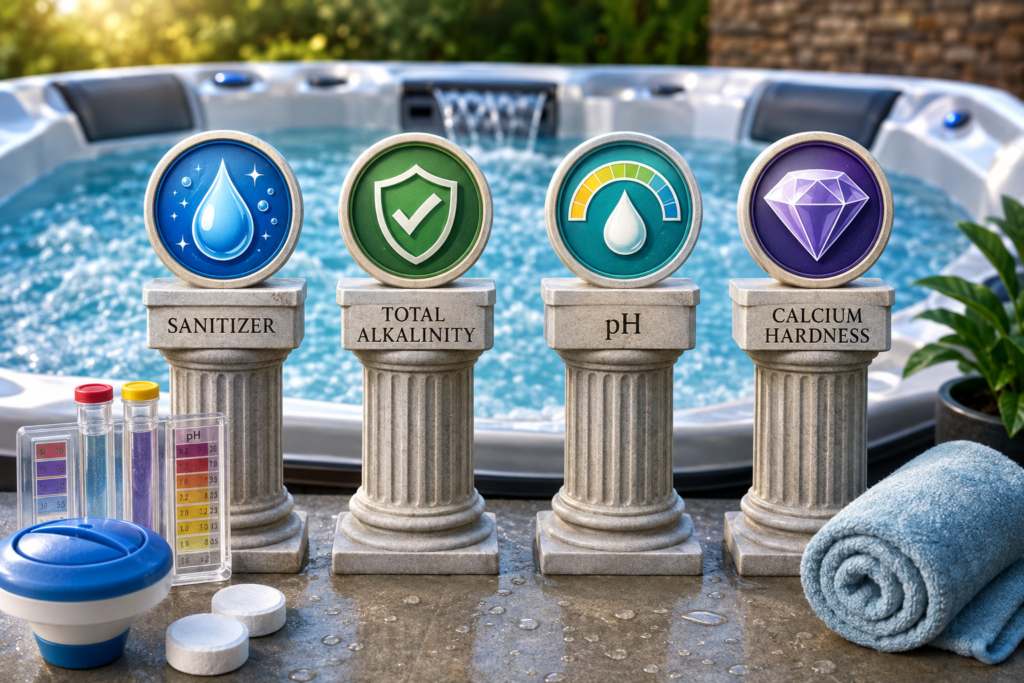
Hot Tub Water Balance: Crystal-Clear Hot Tub Water Starts With These Four Pillars
Everything You Need to Know About Keeping Your Spa Water Clean, Safe, Clear, and Easy to Maintain
Whether you’ve owned a hot tub for twenty years or just purchased your very first spa, one thing quickly becomes apparent:
Water care can either be incredibly simple—or incredibly frustrating.
One week your water is crystal clear. The next week it’s cloudy. The chlorine disappears overnight. Foam suddenly appears when the jets are on. The pH won’t stay where you put it, and no matter how many chemicals you add, the water just doesn’t seem “right.”
Sound familiar?
The good news is that these aren’t random problems.
Nearly every water issue can be traced back to one of four essential measurements that make up the foundation of every healthy hot tub.
What This Report Breaks Down
Think of this report as your master blueprint for understanding hot tub water chemistry.
Instead of memorizing dozens of chemical products and complicated instructions, you’ll learn why water behaves the way it does—and how four simple measurements work together to keep your spa clean, comfortable, and protected.
By the time you’ve finished this guide, you’ll understand:
- What each pillar actually does
- Why they depend on one another
- How to recognize when something is out of balance
- How to correct problems before they become expensive repairs
- How balanced water saves money, chemicals, and time
- Why proper water balance is the secret to crystal-clear water year-round
If there’s one article every hot tub owner should bookmark, it’s this one.
Let’s dive in.
🏛️ What Are the Four Pillars of Water Balance?
Every hot tub—regardless of brand, size, or sanitizer system—is built on the same four water chemistry fundamentals.
They are:
🧼 Sanitizer
🛡️ Total Alkalinity
⚖️ pH
💎 Calcium Hardness
These four measurements work together to create healthy water. Imagine trying to build a house with only three walls. Or driving a car with one flat tire.
Everything technically still works—but not very well.
Water chemistry is exactly the same.
When one pillar falls out of balance, it places stress on every other pillar, making the entire system less stable.
That’s why experienced spa owners don’t chase symptoms—they maintain balance.
🌊 Why Water Balance Matters
Many people believe water balance is simply about keeping the water looking clear.
In reality, balanced water affects every part of your hot tub experience.
Proper water chemistry helps:
- Keep water crystal clear
- Destroy bacteria and contaminants
- Make the water comfortable for your skin and eyes
- Protect pumps, heaters, and plumbing
- Extend the life of your spa cover
- Improve sanitizer efficiency
- Reduce chemical costs
- Minimize maintenance time
Poor water balance, on the other hand, can lead to:
- Cloudy water
- Foam
- Scale buildup
- Corrosion
- Skin irritation
- Strong chemical odors
- Biofilm development
- Premature equipment failure
The goal isn’t just clean water. The goal is stable water.
🧠 Understanding How the Four Pillars Work Together
One of the biggest mistakes new spa owners make is treating each water parameter as if it exists on its own.
It doesn’t. Every pillar influences the others.
For example:
➡️ High alkalinity often causes pH to rise.
➡️ Low calcium hardness makes water aggressive, increasing the risk of corrosion.
➡️ High pH reduces chlorine’s sanitizing efficiency.
➡️ Low sanitizer allows contaminants to build up, making it much harder to maintain balanced water.
It’s a chain reaction. That’s why experienced technicians always focus on balance, not individual numbers.
🧼 Pillar One: Sanitizer
🎯 What Does Sanitizer Do?
Sanitizer is the workhorse of your water care system.
Its job is to eliminate harmful bacteria, viruses, and contaminants before they become a problem.
Every time someone enters the spa, they introduce:
- Sweat
- Body oils
- Soap residue
- Cosmetics
- Organic contaminants
- Micro Organisms
Without adequate sanitizer, these contaminants quickly multiply in warm water.
🧪 Common Sanitizer Systems
Most residential spas use one of these:
- Chlorine
- Bromine
- Saltwater chlorine generators
- Mineral systems paired with chlorine
Each system works differently, but all aim to maintain safe, sanitized water.
✅ Ideal Levels
Free Chlorine: 3–5 ppm
Bromine: 3–5 ppm
Always follow your manufacturer’s recommendations, especially for saltwater systems.
🚨 Signs Sanitizer Is Too Low
- Cloudy water
- Slimy surfaces
- Odors
- Poor water clarity
- Increased sanitizer demand
⚠️ Signs Sanitizer Is Too High
- Skin irritation
- Eye irritation
- Dry skin
- Harsh chemical smell
- Cover deterioration
🛡️ Pillar Two: Total Alkalinity
📖 What Is Total Alkalinity?
Total alkalinity acts as your spa’s chemical shock absorber.
It doesn’t clean the water. Instead, it stabilizes pH so it doesn’t constantly rise and fall.
Without proper alkalinity, maintaining pH becomes almost impossible.
🎯 Ideal Range
80–120 ppm
(Some manufacturers recommend lower ranges for certain systems.)
🌟 Benefits
- Stabilizes pH
- Reduces chemical use
- Protects equipment
- Makes water easier to maintain
📉 Low Alkalinity
- pH constantly drops
- Corrosion
- Increased chemical demand
📈 High Alkalinity
- pH continually rises
- Scale
- Cloudy water
⚖️ Pillar Three: pH
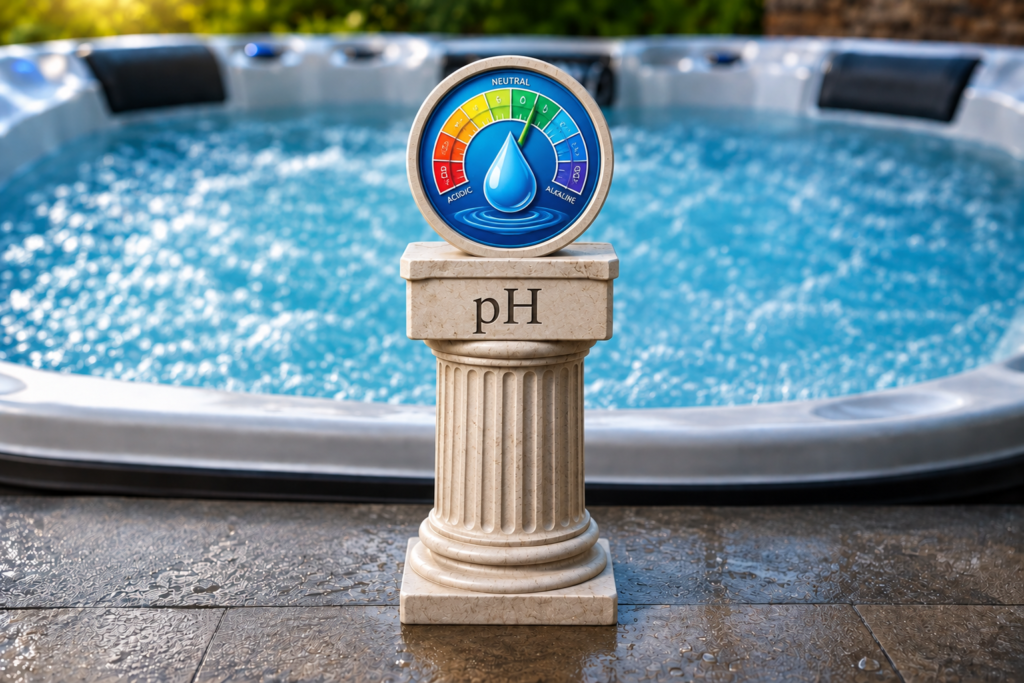
📖 What Is pH?
pH measures how acidic or basic your water is.
The pH scale runs from:
🔴 0–6.9 = Acidic
⚪️ 7 = Neutral
🔵 7.1–14 = Alkaline
🎯 Ideal Range
7.2–7.8
Most spas perform best around: 7.4–7.6
🌟 Why pH Matters
Balanced pH:
- Improves comfort
- Helps sanitizer work properly
- Protects equipment
- Reduces scale
- Prevents corrosion
📉 Low pH
Can cause:
- Corrosion
Eye irritation
Heater damage
Rapid sanitizer loss
📈 High pH
Can cause:
- Scale
- Cloudy water
- Poor chlorine efficiency
- Mineral deposits
💎 Pillar Four: Calcium Hardness
📖 What Is Calcium Hardness?
Calcium hardness measures the amount of dissolved calcium in the water.
- Too little calcium makes the water aggressive.
- Too much causes mineral deposits.
🎯 Ideal Range
150–250 ppm
Always consult your spa manufacturer’s recommendations if they differ.
🌟 Why It Matters
Balanced calcium helps:
- Protect heater elements
- Protect pumps
- Improve water stability
- Reduce foaming
- Minimize scaling
📉 Low Calcium
May cause:
- Foam
- Corrosion
- Equipment wear
📈 High Calcium
May cause:
- White scale
- Cloudy water
- Reduced heater efficiency
🔄 The Proper Testing Order
One of the easiest ways to avoid frustration is testing and adjusting in the proper order.
Always adjust:
1️⃣ Total Alkalinity
2️⃣ pH
3️⃣ Calcium Hardness
4️⃣ Sanitizer
Following this order creates a stable foundation before fine-tuning the rest of your chemistry.
📅 How Often Should You Test?
🌊 Before Every Soak
- Sanitizer
- Water temperature (recommended)
📆 Weekly
- pH
- Total Alkalinity
- Sanitizer
- Filter condition
- Water level
🗓️ Monthly
- Calcium Hardness
- Deep-clean filters
- Inspect overall water condition
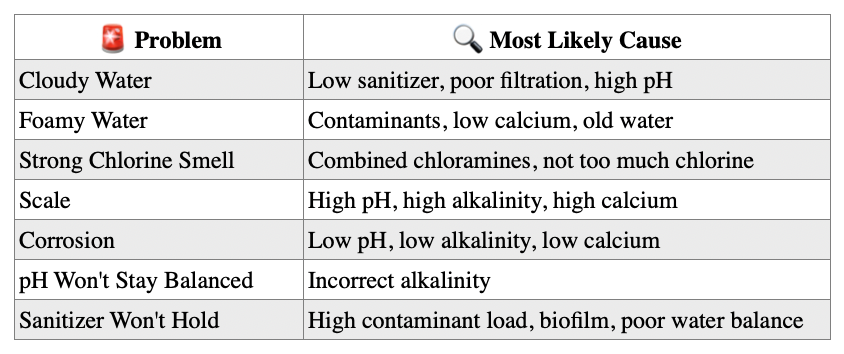
🚩 Common Water Problems and Their Causes
Every hot tub—regardless of brand, size, or sanitizer system—is built on the same four water chemistry fundamentals.
They are:
⭐ Best Practices for Easy Water Care
✔️ Test your water consistently.
✔️ Make small chemical adjustments.
✔️ Allow the water to circulate before retesting.
✔️ Clean your filters regularly.
✔️ Drain and refill your spa every 3–4 months (or as recommended based on use and water quality).
✔️ Shower before soaking to reduce oils and lotions entering the water.
✔️ Address small issues before they become large ones.
🌊 Final Thoughts
The Hot Tub Report Trusted Links & References
Recommended Reads from The Hot Tub Report
💬 Join the Conversation!
Have a question, tip, or hot tub story to share? Jump in! The Hot Tub Report is all about helping each other get more enjoyment out of hot tub ownership.
Just keep it friendly, helpful, and on topic. No spam, personal attacks, or inappropriate content, please. Comments that don’t fit the spirit of the community may be removed.
Be helpful. Be respectful. And happy hot tubbing! 🛁