10 Hot Tub Features That Actually Matter (And Are Worth Paying For)
What Really Adds Value? The Hot Tub Features That Matter Most
Shopping for a new hot tub should be exciting, but comparing models can get confusing pretty quickly. Between jet counts, horsepower ratings, insulation, and water-care systems, every manufacturer has a different explanation for why its hot tub belongs in your backyard.
So how do you decide what deserves your attention—and your money?
If you’ve read The 10 Most Overrated Hot Tub Features (And What Actually Matters), you’ve seen how some selling points can get more attention than they deserve. Here, we’ll look at the features that can make a lasting difference in how much you enjoy your hot tub.
After more than 20 years in the hot tub industry, one thing stands out to me: the features you appreciate after five years of ownership aren’t always the ones that caught your eye in the showroom.
Comfortable seating, manageable maintenance, and dependable service might not make the flashiest sales presentation. But they matter every time you use your hot tub.
Here are 10 buying considerations I think deserve a closer look.
📋 What You’ll Learn in This Report
How to judge seating comfort and massage performance.
What to ask about insulation and energy use.
Why cover density, thickness, and taper all matter.
How circulation pumps affect filtration and pump workload.
What makes water care easier to manage.
Why plumbing, construction, and service access deserve attention.
How to evaluate the warranty and the dealer behind it.
🛋️ 1. Comfortable Seating: Make Sure the Hot Tub Fits You
Comfortable seating might seem like an obvious place to start, but it’s easy to overlook when you’re comparing jets, pumps, and all the extras. You’re buying a hot tub to relax, so make sure you actually enjoy sitting in it.
A model can have everything you want on paper and still feel wrong once you get in. The seats might be too deep, the footwell too crowded, or the lounger a poor fit for your body.
💦 Seat Count Doesn’t Tell You How Comfortable You’ll Be
Hot tub seats vary in depth, shape, and support. A seat that feels great to someone who’s six feet tall may leave a shorter person struggling to keep their shoulders above water.
Loungers are especially personal. A lounger that fits you can be a favorite spot, but one that leaves you floating out of position probably won’t get much use.
That’s why I encourage buyers to wet-test whenever possible. Sitting in an empty hot tub can help you check the layout, but water changes how your body settles into the seats and how the massage feels.
Pay attention to the footwell, too. A hot tub advertised for seven people may technically have seven seats, but that doesn’t tell you how comfortably everyone’s legs and feet will fit.
✅ What to look for: Comfortable seat depth, good support, enough legroom, and a layout that works for the people who will use it most.
💬 John’s Take: Shop for the people who will regularly use your hot tub. Don’t give up everyday comfort just to squeeze in an extra seat for an occasional gathering.
💦 2. Massage Performance: Look Beyond the Jet Count
A hot tub with 70 jets isn’t automatically going to give you a better massage than one with 40. What matters is where those jets are positioned, how they feel, and whether the system gives you the massage you enjoy.
The seats, jets, pumps, and plumbing all need to work together. An impressive horsepower rating won’t make up for jets that miss the areas you want to massage.
🎯 Try Different Seats and Jet Settings
Some jets deliver a concentrated stream of water, while others provide a broader or rotating massage. You may enjoy strong pressure on your lower back but prefer something gentler around your shoulders.
Adjustability helps you find that balance. During a wet test, try the different seats and ask the dealer to show you how the jet controls and diverter valves work, if the model has them. Notice whether changing the settings affects the other seats.
If two of you usually soak together, check whether you can both get a comfortable massage at the same time.
More pressure doesn’t automatically mean a better massage. A strong jet in the wrong position can have you moving away from it instead of settling in.
✅ What to look for: Comfortable jet placement, a useful mix of massage sensations, adjustable intensity, and good performance in the seats you’ll actually use.
❄️ 3. Insulation: Pay Attention to What Holds the Heat In
Insulation doesn’t draw a crowd in the showroom, but it deserves your attention. Your hot tub needs to maintain warm water between uses, and the heat it loses has to be replaced.
That becomes especially noticeable during cold weather.
🌡️ Look at the Complete Insulation System
Manufacturers take different approaches. Some fill much of the space between the shell and cabinet with foam. Others insulate around the cabinet perimeter, and some combine methods.
You’ll hear strong opinions about which approach is best. I’d look beyond the label and ask how well the complete hot tub holds its heat.
Foam coverage, insulation materials, cabinet design, unwanted air leakage, and the cover all play a part. Simply hearing “full foam” or “perimeter insulation” doesn’t tell you everything you need to know.
💰 Ask for Useful Energy Information
Ask whether the manufacturer provides standardized energy-use data for the model you’re considering. If the dealer quotes a monthly operating cost, find out what electricity rate, outdoor temperature, and usage assumptions were used.
An estimate based on mild weather and inexpensive electricity may look quite different from your experience during a cold winter.
Your water temperature, soaking habits, and time spent with the cover off also affect consumption. Use estimates to help compare models, rather than treating them as a promise of what your bill will be.
✅ What to look for: Thorough insulation, a well-fitted cabinet and cover, and energy-use information with clear testing conditions or assumptions.
🛡️ 4. A Quality Cover: Thickness Is Only Part of the Story
The cover deserves more attention than it usually gets when you’re buying a hot tub. A good one helps hold in heat, sheds rainwater, and is manageable enough that removing it doesn’t become a chore.
For a traditional foam-core cover, thickness matters—but so do foam density, moisture protection, and fit.
🧊 Compare Foam Density and Thickness Together
Most traditional covers use expanded polystyrene foam, commonly called EPS. You’ll often see foam densities listed as 1, 1.5, or 2 pounds per cubic foot.
That number describes how much a given volume of foam weighs. Higher-density EPS generally provides greater strength and somewhat better insulation per inch than lower-density EPS.
So a thicker cover isn’t automatically the better-insulated choice. A denser foam core can improve insulating performance, but whether it outperforms a thicker, lower-density core depends on the actual specifications.
Ask about both thickness and density, rather than choosing by appearance alone.
If the seller provides an R-value—a measure of resistance to heat flow—ask what that number represents. A rating for the foam at its thickest point isn’t the same as a rating for the complete cover. Comparisons are useful only when the numbers are based on similar measurements.
🌧️ A Taper Helps Water Run Off
A tapered cover is thicker near the middle and thinner toward the outside edges. A 5-to-3-inch cover, for example, is approximately five inches thick at the center and three inches at the edges.
That slope helps rainwater and melting snow drain away instead of collecting on top.
Standing water adds weight, which can contribute to sagging. Once a low spot develops, it can collect even more water. A suitable taper helps reduce that problem, although it doesn’t remove the need to clear heavy snow according to the cover manufacturer’s instructions.
💦 Check Moisture Protection and Fit
The foam core is usually wrapped in a vapor barrier to help keep moisture out. If that protection fails, the cover can become waterlogged, heavier, and less effective at holding heat.
Ask about the vapor barrier and its seams, along with the seal around the edge of the hot tub and across the folding hinge. Good foam can only do so much if the cover leaves gaps for heat to escape.
💪 Make Sure You Can Handle It
A cover lifter is an accessory I’d give serious consideration. Covers are bulky, and a suitable lifter makes removing, supporting, and replacing one much easier.
Ask the dealer to demonstrate it and check how much clearance it needs behind or beside the hot tub. The cover and lifter need to work with your installation space as well as your ability to use them.
✅ What to look for: Suitable foam density and thickness, a tapered design, durable vapor protection, a snug fit, and manageable cover removal.
💬 John’s Take: Ask the dealer to explain the cover that comes with the hot tub. It’s part of the purchase, and its quality deserves the same attention you give the equipment underneath.
⚡ 5. Filtration and Circulation: Consider How the Water Keeps Moving
Filtration is about more than the size of the filter. The pump moving water through it also affects electricity use, noise, and how much work your main jet pump has to do.
Some hot tubs use a small, dedicated circulation pump. Others use the low-speed setting on a larger, two-speed jet pump. Both approaches can work well.
💦 What a Dedicated Circulation Pump Adds
A dedicated circulation pump takes routine circulation duties off the main jet pump, reducing the hours it needs to run for those tasks.
That lighter workload can mean less wear and may help the main pump last longer. It’s a practical benefit worth considering, although pump life also depends on equipment quality, operating conditions, and maintenance.
The trade-off is having another pump that may eventually need repair or replacement. Ask what a replacement circulation pump costs and how easily it can be serviced.
💰 Compare Electricity Use Over Time
A small circulation pump generally draws less power while running than a larger two-speed jet pump operating on low speed. That can make it an economical way to circulate water.
Operating hours still matter, though. A small pump running around the clock won’t necessarily use less electricity per day than a larger pump running for a shorter filtration cycle.
Ask about wattage and daily running time together. Those details give you a more useful comparison than simply being told a model has an “energy-efficient pump.”
🔧 Less Routine Work for the Main Pump
A dedicated circulation pump also takes routine filtration duties off the main jet pump, leaving it to handle the massage.
Reducing those operating hours may reduce wear and potentially help the main pump last longer. It isn’t a guarantee—pump life also depends on the equipment, operating conditions, and maintenance—but it’s a practical benefit worth considering.
The trade-off is that the circulation pump is another component that may eventually need repair or replacement.
🧽 Keep Filter Maintenance Simple
Whichever system you choose, ask the dealer to show you how the filters come out. Check whether they’re easy to reach and find out what replacements cost.
Regular filtration helps remove particles from the water, but it still needs to work alongside proper sanitation and water balance.
✅ What to look for: Effective filtration, reasonable electricity use, quiet operation, accessible filters, and clear maintenance instructions.
💬 John’s Take: I like dedicated circulation pumps for their quiet operation, low power draw, and the work they take off the main pump. I’d still consider a well-designed two-speed system, but circulation is a feature I’d include in the comparison.
🧴 6. Water-Care Systems: Choose Something You Can Live With
Most owners want water care to be straightforward. You should understand what your system does, what you still need to do, and what it will cost to maintain.
Saltwater systems, ozone, UV, and sanitizer cartridges can serve different purposes. They shouldn’t all be treated as interchangeable ways to make maintenance disappear.
💦 Understand What the System Actually Does
A saltwater chlorine generator makes chlorine from dissolved salt. It can simplify chlorine delivery, but it doesn’t make the water chlorine-free.
Ozone and UV provide supplemental treatment. They don’t replace the need to maintain an appropriate sanitizer residual in the water.
Cartridge systems can make product delivery more convenient, but they still require monitoring and timely replacement.
Whatever the system, you’ll still have a routine that includes water testing, balancing, filter cleaning, and water changes when needed.
💰 Ask About the Routine and the Running Costs
Have the dealer walk you through a typical week of maintenance. Then ask what needs replacing over a year and what those items cost.
Depending on the system, that might include sanitizer cartridges, salt cells, sensors, or other consumables and components.
Paying extra for convenience may be worthwhile. The important thing is knowing what convenience you’re buying and what responsibilities remain.
✅ What to look for: Clear instructions, a manageable routine, readily available supplies, and ongoing costs you’re comfortable with.
💬 John’s Take: The best water-care system for you is one you understand and will use consistently. A more advanced system isn’t much help if maintaining it feels confusing.
⚙️ 7. Plumbing Design: Good Massage Starts Behind the Panels
Plumbing rarely gets much attention during a showroom visit, but it helps determine how effectively water reaches the jets.
Pipe sizing, fittings, valves, and layout all influence flow. A well-designed system delivers water where it’s needed without unnecessary restrictions.
This is another reason horsepower alone tells you so little about the massage. The pump has to work with the plumbing and jets around it.
🔧 Ask About Design and Assembly
Some manufacturers reduce the amount of plumbing or the number of connections in their designs. Fewer connections can mean fewer potential leak points, but the quality of the materials and assembly still matters.
You don’t need to become a plumbing expert to shop wisely. Ask the dealer to explain the system, how it distributes water between seats, and what coverage applies to plumbing leaks.
Then check the result during your wet test. The design should deliver comfortable, useful performance where you want it.
✅ What to look for: Thoughtful water distribution, quality materials and connections, and massage performance that supports the dealer’s claims.
🏗️ 8. Construction Quality: Look Under the Finish
A polished shell and attractive cabinet can make a great first impression. The structure underneath has to support years of use, with the hot tub full of water and exposed to outdoor conditions.
🛁 Ask How the Shell Is Supported
Manufacturers use different shell materials and reinforcement methods. Many hot tubs have reinforced acrylic shells, while others use different construction approaches.
A material name alone doesn’t establish quality. Ask how the shell is supported, how the frame is built, and what the structural warranty actually covers.
You want a clear explanation of how the pieces work together, rather than a sales pitch based on one material being superior in every situation.
🏡 Look at the Cabinet and Base
Check how the cabinet is designed to handle sunlight, moisture, and seasonal temperature changes. Ask what upkeep it needs and whether individual panels can be replaced if damaged.
The base deserves attention, too. A well-designed base helps protect the structure and equipment from conditions underneath the hot tub. Ask about moisture protection and potential pest entry points, especially around openings for wiring or plumbing.
While the dealer has a panel open, look at how the equipment is arranged. That leads directly to the next consideration.
✅ What to look for: A properly supported shell, durable structural materials, a weather-resistant cabinet, and a protective base.
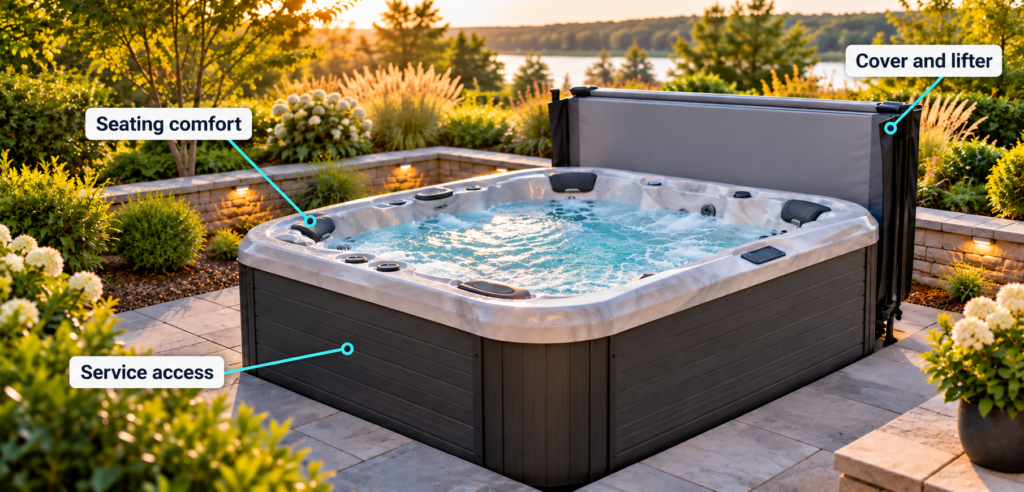
🔧 9. Serviceability: Think About Access Before There’s a Problem
Pumps, heaters, controls, and sensors may eventually need attention. How easily a technician can reach them can affect the time and cost involved.
Equipment crowded into a tight space may take more work to remove. A plumbing repair can also become more involved if a technician has to remove insulation or other components to reach the leak.
🛠️ Check Equipment and Installation Access
Ask which panels provide service access and how much room needs to remain around the hot tub.
This matters when planning a deck, surround, or landscaping. Even an easy-to-service model becomes difficult to repair if the required panel is blocked.
📦 Ask About Replacement Parts
Find out how the dealer obtains replacement pumps, controls, and other components. Some parts are widely available, while others are specific to a manufacturer or model.
Proprietary parts aren’t automatically a problem, but availability, pricing, and ongoing manufacturer support are worth discussing.
No dealer can promise every part will always be on the shelf. They should be able to explain how they support older models and what happens when something needs ordering.
✅ What to look for: Accessible equipment, adequate space around service panels, and dependable parts support.
🤝 10. Warranty and Dealer Support: Know Who Will Help
The dealer can have a major influence on your ownership experience. Good guidance during the purchase matters, but so does having someone dependable to contact afterward.
🛡️ Read the Actual Warranty
A “five-year warranty” doesn’t necessarily mean every part of the hot tub is covered for five years.
The shell, plumbing, equipment, cabinet, and accessories may have different coverage periods or exclusions. Labor coverage may also differ, and travel or service-call charges may apply.
Ask for the warranty document before buying. Have the dealer explain anything unclear, including your maintenance responsibilities and how claims are handled.
🏬 Find Out Who Performs the Repairs
One of the most useful questions you can ask is:
“If something goes wrong, who comes to my house to fix it?”
Does the dealer employ technicians, work with an independent service company, or expect you to arrange service yourself? Do they cover your location, and will they continue providing service after the warranty expires?
Also ask what help you receive at delivery. Learning how to use the controls, care for the water, and clean the filters makes those first weeks much easier.
✅ What to look for: Understandable warranty coverage, dependable service in your area, parts support, and help learning the maintenance routine.
💬 John’s Take: I’d give the dealer serious weight in the buying decision. A hot tub you like becomes a much better purchase when there’s dependable support behind it.
📊 Quick Comparison: The Hot Tub Features That Matter Most
| Feature | Why It Matters |
|---|---|
| Comfortable seating | Helps you relax without cramped legs, awkward positioning, or a poor fit |
| Quality massage system | Delivers a massage you enjoy, with useful control over intensity |
| Effective insulation | Reduces heat loss and helps manage heating costs |
| Quality cover | Holds in heat, sheds rainwater, and makes covering the hot tub manageable |
| Efficient circulation and filtration | Supports water clarity while affecting electricity use and pump workload |
| Practical water care | Makes sanitation and routine maintenance easier to manage |
| Well-designed plumbing | Helps deliver water efficiently to the jets |
| Quality construction | Supports durability through years of outdoor use |
| Easy service access | Makes equipment inspection, repairs, and replacement more straightforward |
| Warranty and dealer support | Gives you a clear path to help when you need it |
✅ Five Questions I’d Ask Before Buying a Hot Tub
1. Does It Fit the People Who Will Use It Most?
Wet-test if possible. Check seat depth, legroom, and how the massage feels when you’re sitting naturally.
2. What Should I Expect to Spend After Delivery?
Look beyond the purchase price to electricity, water-care supplies, filters, and replacement components.
3. Can I Manage the Maintenance Routine?
Have the dealer demonstrate filter removal, explain water care, and show you how the cover and lifter operate.
4. Who Handles Repairs in My Area?
Get a clear answer about service coverage, warranty labor, possible travel charges, and support after the warranty ends.
5. Will These Features Still Matter to Me in Five Years?
Think about your usual evening in the hot tub. The features that make that experience comfortable and easy are likely to provide the most lasting value.
🧠 Final Thoughts: Buy a Hot Tub You’ll Enjoy Owning
The hot tubs I’d encourage you to look at closely are the ones that get the everyday details right: comfortable seating, an enjoyable massage, good heat retention, manageable water care, and dependable support.
There’s nothing wrong with wanting beautiful lighting, a sound system, or connected controls. Those extras can add to your enjoyment. Just make sure you’re equally happy with how the hot tub feels, what it takes to maintain, and who will help if it needs service.
Spend your money on the features that improve the way you’ll actually use and own your hot tub. That’s where you’re most likely to find lasting value.
🔍 Recommended Next Read: Which Features Are Overrated?
Now that you know what deserves attention, take a look at the features that don’t always live up to the sales pitch. Our companion report explains when high jet counts, horsepower claims, and other popular extras are worth considering—and when they deserve less weight in your decision.
👉 Read The 10 Most Overrated Hot Tub Features (And What Actually Matters)
Looking for Another Hot Tub Answer?
Search The Hot Tub Report for more water care, troubleshooting, and buying advice.
A Little More Hot Tub Know-How, Delivered
Get practical water care tips, maintenance advice, and helpful reports delivered right to your inbox. It’s free, and it’s all about making hot tub ownership a little easier.
HOT TUB CONCIERGE SERVICE
Need a Little More Help?
Sometimes a little one-on-one guidance makes all the difference.
Whether you’re shopping for a hot tub, troubleshooting a water problem, or just looking for some expert advice, I’m here to help.
Get personalized guidance during a 30-minute Hot Tub Concierge consultation.
Recommended Reads From The Hot Tub Report
Looking for more helpful advice? Explore these related reports for additional hot tub tips, practical guidance, and answers to common ownership questions.
💬 Join the Conversation!
Have a question, a helpful tip, or a hot tub experience to share? Drop a comment below! We’re here to help each other enjoy better hot tub ownership.
Please keep comments friendly, helpful, and on topic.